

As a proud supplier of Partition Box HEPA filters, I'm constantly intrigued by the materials that go into making these essential air - purification components. HEPA (High - Efficiency Particulate Air) filters are a crucial part of various air - handling systems, especially in environments where air quality is of utmost importance, such as hospitals, cleanrooms, and laboratories.
1. Media Materials
The heart of a HEPA filter is its filtration media. One of the most commonly used materials for HEPA filter media is glass microfibers. These microfibers are extremely thin, typically in the range of 0.5 to 2 microns in diameter. The small diameter of these fibers creates a large surface area, which is essential for capturing particles.
Glass microfibers work through a combination of three mechanisms: interception, impaction, and diffusion. Interception occurs when a particle following the air stream comes into contact with a fiber and adheres to it. Impaction happens when larger particles are unable to follow the curved path of the air around the fibers and collide with them. Diffusion is the process by which very small particles move randomly due to Brownian motion and eventually come into contact with the fibers.
Another material that can be used for HEPA filter media is synthetic fibers. Synthetic fibers, such as polypropylene or polyester, offer certain advantages. They are more resistant to moisture compared to glass microfibers, which can be beneficial in humid environments. Additionally, synthetic fibers can be engineered to have specific properties, such as a more uniform fiber diameter, which can improve the filtration efficiency.
2. Frame Materials
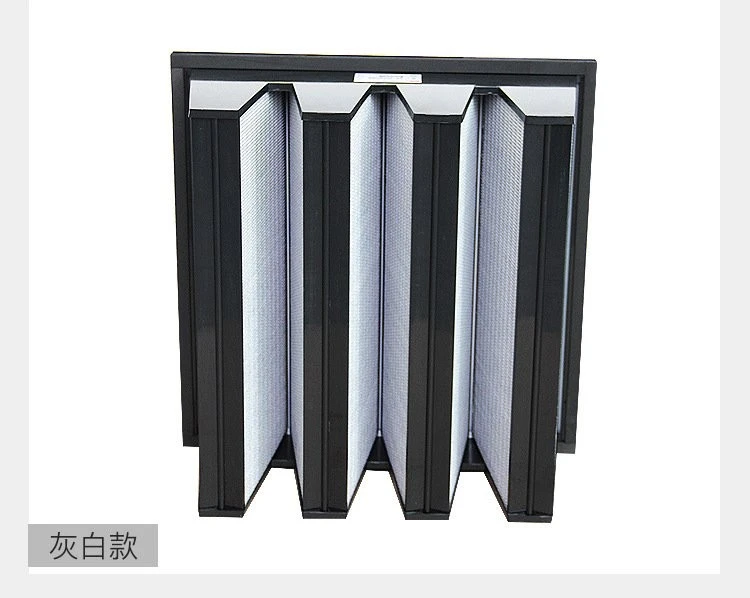
The frame of a Partition Box HEPA filter provides structural support and helps to hold the filtration media in place. One of the most popular frame materials is aluminum. Aluminum frames are lightweight, corrosion - resistant, and easy to manufacture. They can be extruded into various shapes and sizes, making them suitable for different filter designs.
Stainless steel is another option for frame materials. Stainless steel frames are extremely durable and can withstand harsh environments, such as those with high humidity or chemical exposure. They are also resistant to rust and corrosion, which ensures a long service life for the filter.
Plastic frames are also commonly used, especially in applications where cost is a major consideration. Plastic frames can be made from materials such as polycarbonate or ABS (Acrylonitrile Butadiene Styrene). They are lightweight, easy to mold, and can be designed to fit specific filter dimensions.

3. Sealant Materials
Sealants are used to ensure that there are no air leaks between the filtration media and the frame of the HEPA filter. Silicone sealants are a popular choice due to their excellent adhesion and flexibility. Silicone sealants can withstand a wide range of temperatures and are resistant to moisture and chemicals. They create a tight seal that prevents unfiltered air from bypassing the filtration media.
Polyurethane sealants are also used in some HEPA filters. Polyurethane has good bonding properties and can provide a strong seal. It is also relatively easy to apply and can cure quickly, which is beneficial during the manufacturing process.
4. Separator Materials
In a Partition Box HEPA filter, separators are used to keep the pleats of the filtration media evenly spaced. This ensures that the air can flow through the filter evenly and that the filtration efficiency is maintained. One common separator material is aluminum foil. Aluminum foil is lightweight, flexible, and can be easily formed into the required shape. It provides a stable structure for the pleats and helps to prevent them from collapsing.
Another separator material is paper. Paper separators are cost - effective and can be used in applications where the filter is not exposed to high humidity or extreme conditions. They are also relatively easy to handle during the manufacturing process.
5. Our Product Range
As a supplier, we offer a variety of HEPA filter products. For example, our Close Pleat HEPA Filter is designed with a close - pleated structure that maximizes the filtration area. This filter is suitable for applications where high - efficiency particulate removal is required.
Our W Type HEPA Filter Of Low Pressure is specifically engineered to operate at low pressure differentials. This makes it ideal for systems where energy efficiency is a priority.
The Close Pleat Box HEPA Filter combines the advantages of a close - pleated design with a box - type structure. It provides a high - capacity filtration solution for large - scale air - handling systems.
6. Conclusion and Call to Action
In conclusion, the materials used to make a Partition Box HEPA filter play a crucial role in its performance and durability. From the filtration media to the frame, sealant, and separator materials, each component is carefully selected to ensure the highest level of air purification.
If you are in the market for high - quality Partition Box HEPA filters, we invite you to contact us for a detailed discussion about your specific requirements. Our team of experts is ready to assist you in choosing the right filter for your application. Whether you need a filter for a small laboratory or a large industrial facility, we have the products and expertise to meet your needs.
References
- "Fundamentals of Air Filtration" by William C. Hinds
- "Air Filtration: An Integrated Approach to the Theory and Application of Fibrous Filters" by Klaus Willeke and Paul A. Baron